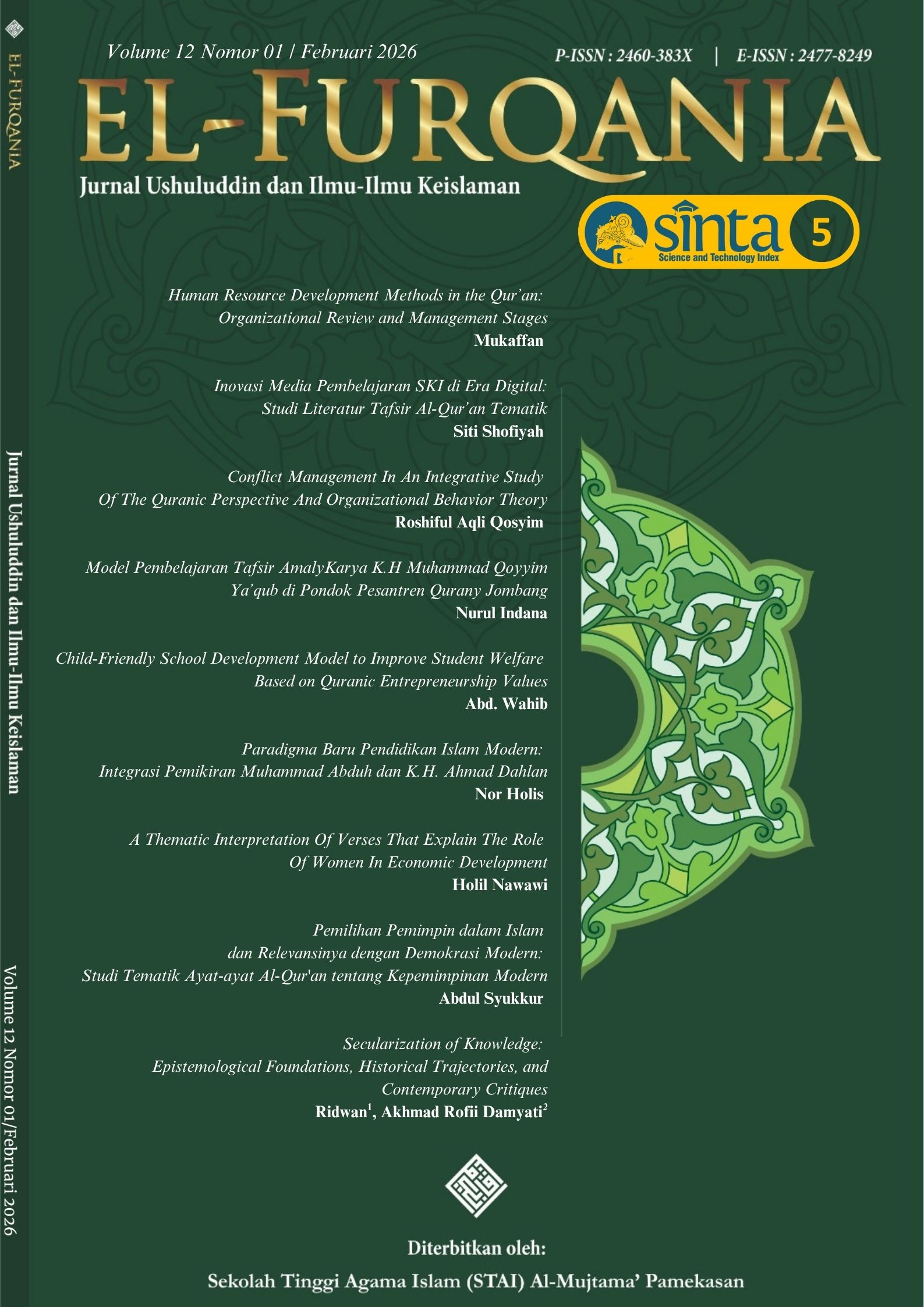
Secularization of Knowledge
Epistemological Foundations, Historical Trajectories, and Contemporary Critiques
DOI:
https://doi.org/10.54625/elf.v12i01.8370Abstract
This article examines the concept of the secularization of knowledge by analyzing its epistemological foundations, historical development, and contemporary critiques. The study focuses on how secularization reshapes the structure of knowledge by separating it from metaphysical and theological frameworks. Employing a qualitative method based on critical literature review, this research engages with classical Western philosophical traditions and modern Islamic intellectual responses. The findings reveal that the secularization of knowledge is not merely an intellectual shift but a civilizational project rooted in Enlightenment rationality, which prioritizes empirical and autonomous reason while marginalizing transcendental sources of truth. Furthermore, contemporary critiques—particularly from Islamic scholars—argue for the reintegration of ethical and metaphysical dimensions into knowledge production. This article concludes that the debate on secularization of knowledge remains central in constructing alternative epistemologies that are both scientifically robust and ethically grounded in the modern world
Downloads
Published
How to Cite
Issue
Section
License
Copyright (c) 2026 Ridwan, Akhmad Rofii Damyati

This work is licensed under a Creative Commons Attribution 4.0 International License.