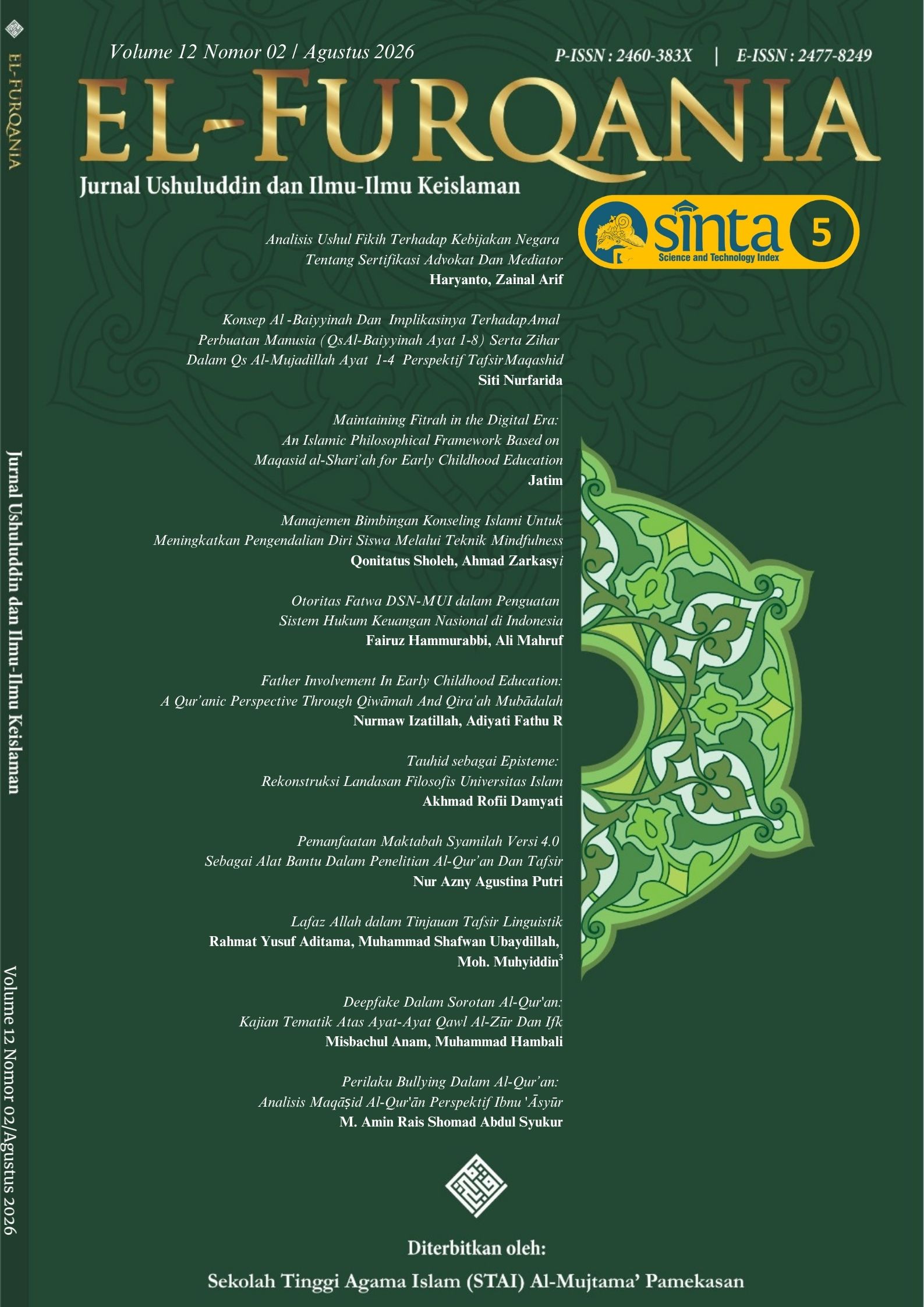
Lafaz Allah dalam Tinjauan Tafsir Linguistik
DOI:
https://doi.org/10.54625/elf.v12i02.8442Abstract
Debates regarding the origins of the term Allah have long existed within Islamic scholarship, particularly concerning its status as either mushtaqq (derived) or murtajal/ghayr mushtaqq (non-derived/proper noun), as well as its potential connection to non-Arabic languages. This study aims to analyze thesse debates from the perspective of linguistic exegesis (tafsir) and to identify the linguistic and theological implications of each viewpoint. A qualitative method with a descriptive-analytical approach was employed, utilizing a literature review of classical Arabic exegetical and linguistic texts. The findings reveal two primary tendencies. The mushtaqq group—including scholars such as al-Nasafi, al-‘Ukbari, and al-Raghib al-Isfahani—links the term Allah to an Arabic derivation, specifically ilah, thereby giving rise to theological interpretations of Allah as the One who is worshipped, the ultimate destination of return, and the ultimate source of reliance. Conversely, scholars such as al-Khazin, ‘Abd al-Khaliq ‘Adimah, al-Kirmani, and al-Safaqusi tend to classify it as murtajal. The study concludes that the historical origin of the term must be distinguished from its status regarding ishtiqaq (derivation) within the Arabic language.
Downloads
Published
How to Cite
Issue
Section
License
Copyright (c) 2026 Rahmat Yusuf Aditama, Muhammad Shafwan Ubaydillah, Moh. Muhyiddin

This work is licensed under a Creative Commons Attribution 4.0 International License.