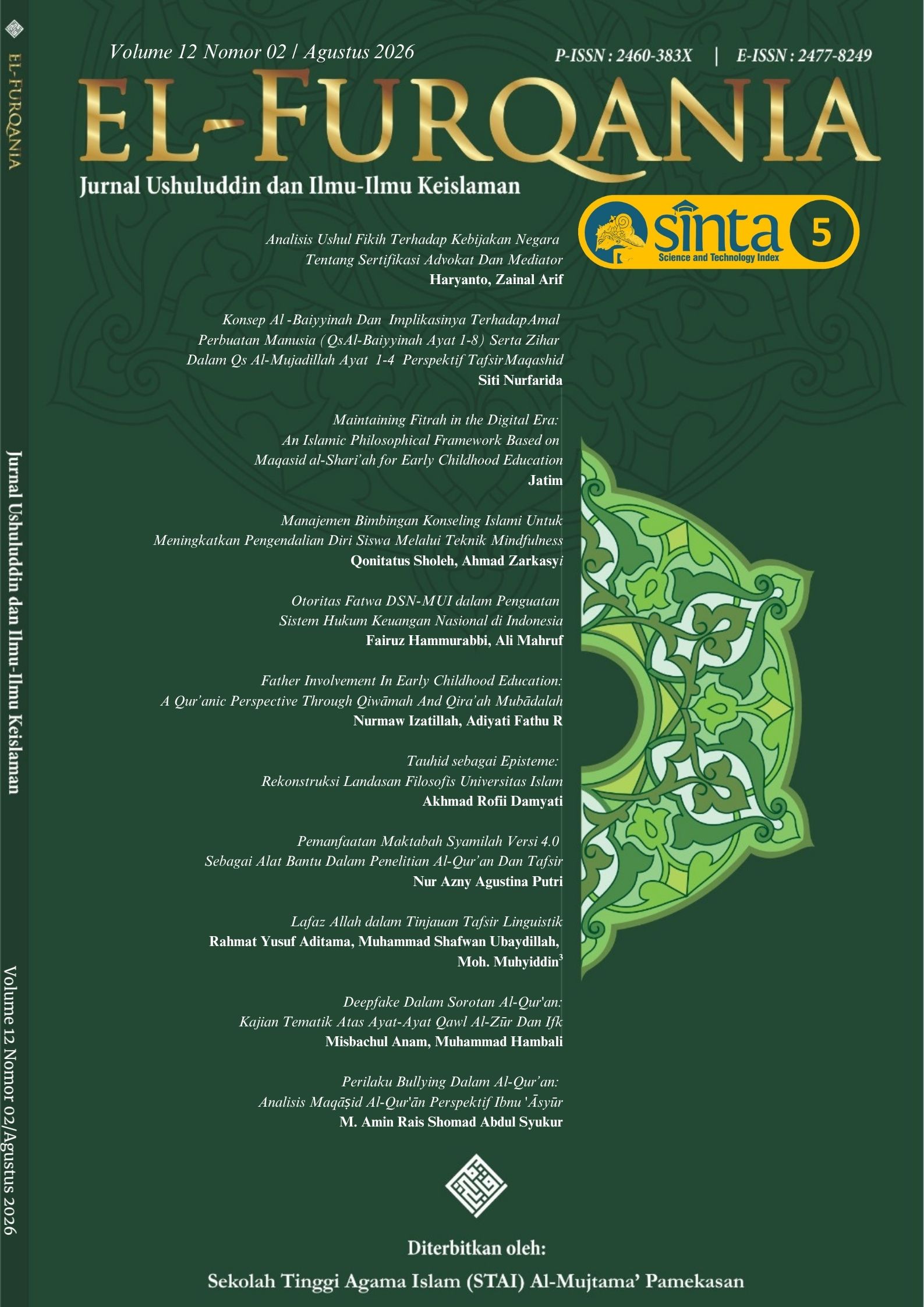
Maintaining Fitrah in the Digital Era: An Islamic Philosophical Framework Based on Maqasid al-Shari’ah for Early Childhood Education
DOI:
https://doi.org/10.54625/elf.v12i02.8430Abstract
Digital transformation has reshaped the early childhood education (ECE) ecosystem while introducing new challenges regarding the maintaining of fitrah. This research aims to develop an Islamic educational philosophy framework that reconstructs the principles of maqāṣid al-sharīʿah into a digital pedagogy paradigm oriented toward the protection of fitrah. The research employs a qualitative approach, utilizing content analysis and a philosophical-interpretative review of classical and contemporary literature concerning maqāṣid al-sharīʿah, Islamic education, early childhood development, and digital technology. The findings indicate that the five universal objectives of maqāṣid al-sharīʿah—ḥifẓ al-dīn, ḥifẓ al-ʿaql, ḥifẓ al-nafs. ḥifẓ al-nasl and ḥifẓ al-māl - can be reconstructed as pedagogical principles capable of addressing both the opportunities and risks associated with digital media exposure regarding a child's spiritual, cognitive, moral, social, and psychological development. Based on these findings, the study develops a maqāṣid-based “Digital Fitrah Protection Model” (DFPM) comprising four integrated dimensions: ontological foundation, epistemological mediation, ethical habituation, and community-based supervision. This model makes a conceptual contribution by bridging classical Islamic educational philosophy with contemporary digital pedagogy, while providing an operational framework for ECE curriculum development, the strengthening of family-school partnerships, and the formulation of digital literacy policies oriented toward protecting the child's holistic development.
Key words: Fitrah; maqāṣid al-sharīʿah; early childhood education programs; digital pedagogy; Islamic education; digital literacy; holistic development of children.
Downloads
Published
How to Cite
Issue
Section
License
Copyright (c) 2026 jatim jatim

This work is licensed under a Creative Commons Attribution 4.0 International License.