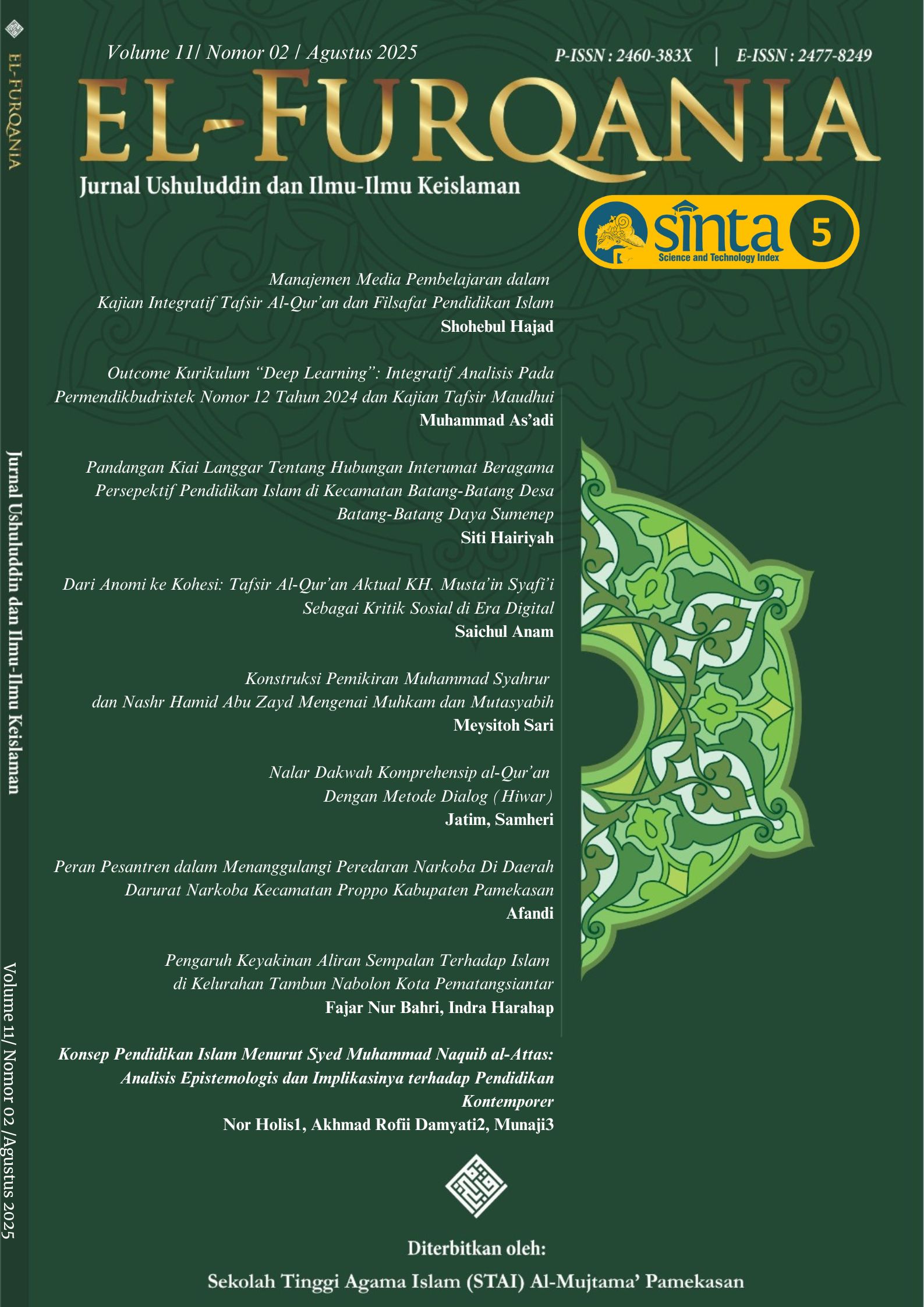
Dari Anomi ke Kohesi Tafsir al-Qur’an Aktual KH. Musta’in Syafi’i Sebagai Kritik Sosial di Era Digital
DOI:
https://doi.org/10.54625/elf.v11i02.8210Abstract
Rapid social change in the digital era often triggers value disorientation and the weakening of social norms that serve as societal guidelines. This condition, which in Émile Durkheim’s perspective is termed anomie, demands the presence of social institutions capable of restoring moral orientation and strengthening social cohesion. This study analyzes the role of Tafsir Al-Qur’an Aktual by KH. Musta’in Syafi’i, published in Harian Bangsa, as a form of social control in addressing anomie in modern society. Using Durkheim’s structural sociology framework, a qualitative method, and a content analysis approach, the tafsir texts are contextualized with contemporary issues. The findings show that Tafsir Al-Qur’an Aktual integrates a contextual approach and communicative language to relate Qur’anic verses to current issues such as the COVID-19 pandemic, educational policy, and leadership crises. This approach strengthens religious norms, fosters public critical awareness, and encourages social participation. The study affirms that mass media can serve as an effective platform for disseminating contextual interpretations that are responsive to the dynamics of the times. Thus, the contribution of Tafsir Al-Qur’an Aktual transcends the boundaries of sacred text exegesis; it functions as an ethical–spiritual guide that facilitates constructive societal adaptation to complex and ongoing social change, while simultaneously emphasizing the urgency of contextual interpretation as an integral component of da’wah strategies and the strengthening of social cohesion in the modern era.
Downloads
Published
How to Cite
Issue
Section
License
Copyright (c) 2025 Saichul Anam

This work is licensed under a Creative Commons Attribution 4.0 International License.