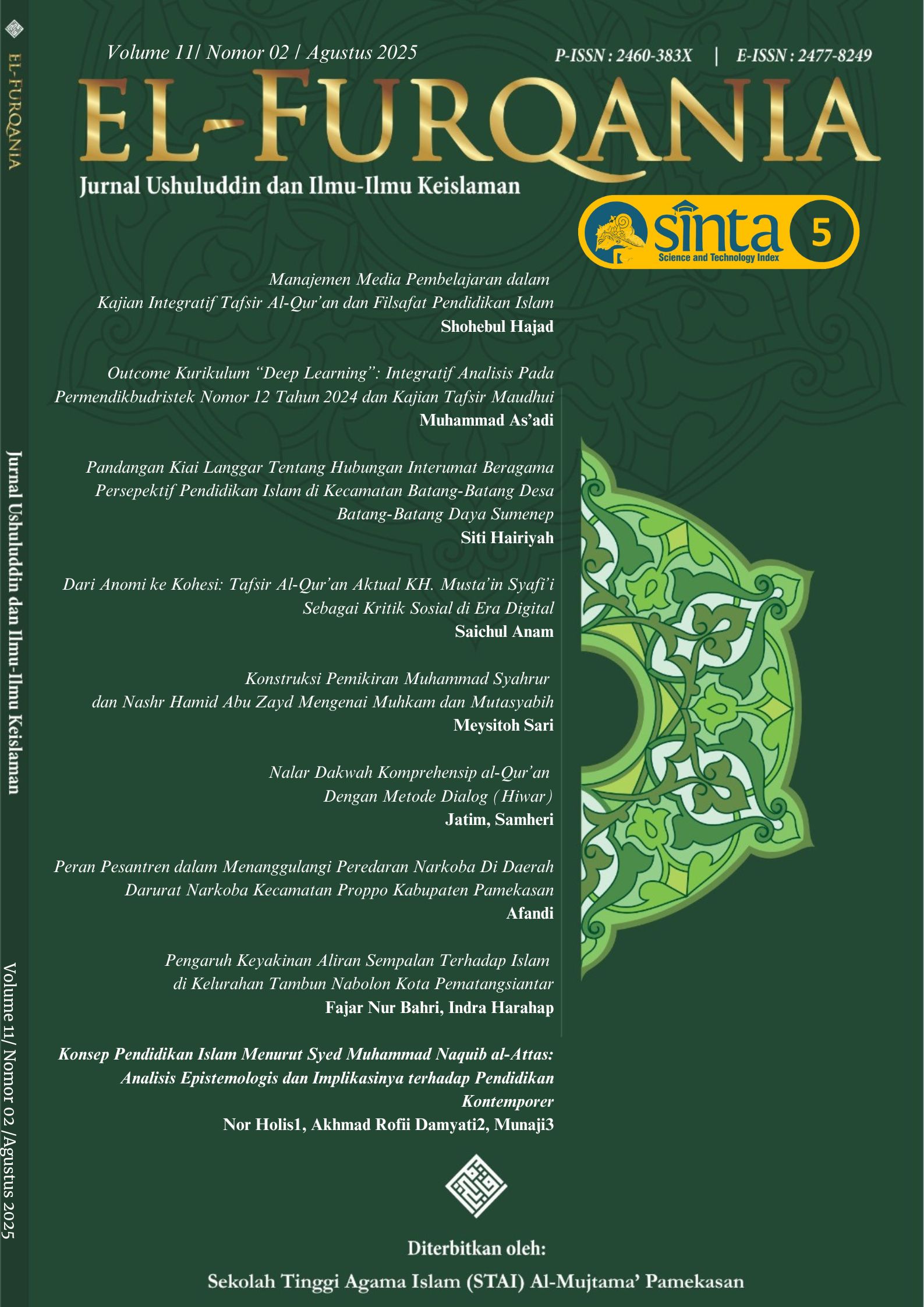
Outcome Kurikulum “Deep Learning”
Integratif Analisis Pada Permendikbudristek Nomor 12 Tahun 2024 dan Kajian Tafsir Maudhui
DOI:
https://doi.org/10.54625/elf.v11i02.8208Abstract
A good curriculum for achieving Islamic educational goals is one that is integrated and comprehensive. This article describes the principles and outcomes of the “deep learning” curriculum: an integrative analysis of Permendikbudristek Number 12 of 2024 and the Maudhui Interpretation Study. This study employs a qualitative approach using library research, collecting data and information from various library materials, such as classical texts, journals, and education system regulations in Indonesia. The analysis of Permendikbudristek No. 12 of 2024 concludes that the main characteristics of an outcome-based curriculum are a focus on clear and measurable learning outcomes; a student-centered approach; performance-based assessment; and continuous improvement. The three dimensions of a deep learning-based curriculum are mindfulness, explained in QS. Ar-Ra'd verse 28, which means tranquility of the heart; meaningfulness, explained in Surah Al-An'am verse 162, which means sincerity; and joyful learning, explained in Surah Al-Hajj verse 78, which means a conducive, calm learning environment where camaraderie is fostered
Downloads
Published
How to Cite
Issue
Section
License
Copyright (c) 2025 Muhammad As'adi

This work is licensed under a Creative Commons Attribution 4.0 International License.